News Headlines

Blue Santa

The Center Police Department's Blue Santa program is getting ready to load the sleigh and needs your help. Blue Santa is asking for donations of new toys, books, or clothes for all ages infant - 13. Monetary donations are also welcomed, and can be given in the form of cash, or check, mailed to 1020 Shelbyville St  Center, Tx 75935 or through PayPal @BlueSantaCPD  or CashApp $CPDOperBlueSanta(please leave a note explaining the money sent)


Toy request forms will be ready to be picked up starting November 1st. If you know of any child in Shelby County that may not have any Santa this Christmas, please have their parent/guardian fill out this form. One form for each child and turn back into the Center Police Department, Shelby County Today, or The Light & Champion. This form will need to be returned to the PD no later than Monday, December 7th, 2025. Any form turned in after the due date will NOT be accepted. This ensures us plenty of time to get all the toys we will need.  Proof of Address/ID will be required to pick up your donations this year.


Forms or Monetary donations can also be mailed to OPERATION BLUE SANTA at 1020 Shelbyville St.  Center, Tx 75935. If you would like to donate new toys, clothing, hygiene items please bring them to the Center Police Dept. Items for boys and girls ages infant to 13yrs old will be needed.  The entire Blue Santa team would like to thank everyone for your generous donation to the Blue Santa program. With your donation and others like yours, we will be able to provide Christmas to many children in Shelby County. Again, thank you, we cannot do it without you!  Together we can make a child's Christmas be blessed. 


Don't forget our BIG Toy Drive,  bring in a toy to donate, and be entered into our raffle for a 32 in Tv and a Christmas goody basket, and a $100 Ivan Smith Furniture Gift Card.


Thank You,

from the Operation Blue Santa Team!

Texas Data Center Showdown: Will Texans Get Cut of Booming AI Wealth?

With the state accounting for an estimated 26% of planned U.S. data center capacity, the economic stakes are enormous. Yet as AI generates extraordinary fortunes for technology billionaires, everyday Texans face mounting household expenses and growing concerns about the infrastructure reshaping their communities. Across the country, voters in more than 30 communities backed restrictions on data center development, sending a message that the industry's traditional approach to neighborhood relations is under increasing pressure.

The real story may not be that Americans hate data centers. It's that they're tired of watching the AI economy create enormous wealth while the people living next to its infrastructure get little direct financial benefit.

Janine Yorio, founder and CEO of Community Digital Technologies, believes Texas developers are unlikely to abandon such an important market. Instead, she argues, they will need to rethink how the wealth generated by AI infrastructure is shared. Consider Ellis County, where Compass Datacenters committed $15 million toward a new animal shelter. The contribution addressed a genuine community need, yet some residents continued raising concerns about development and infrastructure impacts. For Yorio, the example illustrates the distinction between investing in a community and putting economic benefits directly into neighboring households' hands.

Her proposition: The next generation of Texas data centers should help pay the bills of the people living next door.

That could mean negotiated utility-bill relief, recurring payments, shares in AI companies or ownership interests in data center projects. Yorio even raises a provocative possibility: Why shouldn't residents near hyperscale AI infrastructure receive complimentary ChatGPT, Claude or Amazon Prime subscriptions? Such benefits would not replace environmental safeguards or infrastructure protections, but could give households something tangible in return for hosting facilities powering the AI economy.

Yorio argues that traditional zoning hearings and community benefit agreements are not enough on their own. Government can establish protections and development conditions, but delivering direct household-level economic participation requires additional mechanisms. Community Digital Technologies is developing that infrastructure through a platform that verifies nearby residents, organizes communities and facilitates negotiations with data center owners and AI industry participants for potential economic benefits, including shared ownership

Plenty of turkeys this Thanksgiving as wholesale prices hold steady

Shoppers should find plenty of turkeys, with more sales, at grocery stores this Thanksgiving, said a Texas A&M AgriLife Extension Service expert.

Turkeys are expected to be plentiful in grocery stores this Thanksgiving, with shoppers likely to find holiday promotions and competitive prices, according to Texas A&M AgriLife Extension Service economist David Anderson. (Michael Miller/Texas A&M AgriLife )

David Anderson, Ph.D., AgriLife Extension economist and professor in the Texas A&M Department of Agricultural Economics, said wholesale and retail prices are slightly higher per pound than last year, but market factors suggest shoppers can find deals on centerpiece Thanksgiving turkeys.

In late October, wholesale whole turkeys averaged $1.80 per pound, Anderson said. That compares with $1.69 per pound for the same week last year, when wholesale prices had jumped 70% from 99 cents. Wholesale prices this year have run consistently higher than in 2025, he said, but the gap has narrowed.

Wholesale prices are what grocers and other retailers pay suppliers in the “spot” market, not what shoppers pay at the register. The spot market is where buyers who need turkeys and sellers who have them make a deal that may not reflect earlier contracted bird prices. Anderson said retail turkey prices often reflect store promotions and earlier contracted prices more than the wholesale spot market.

So, what will shoppers actually pay?

“National average grocery store prices for whole, conventionally produced, frozen turkeys in early November averaged $1.26 per pound compared to $1.03 a year ago,” Anderson said. “Of course, your store may have a different price, and they may have promotions to draw shoppers.”

Turkey production rebounds

Turkey production has recovered from last year’s decline of more than 8%. The number of birds going to market is up about 3%, and heavier average weights push total pounds of production up nearly 6%.

“That tells me there are plenty of turkeys,” Anderson said.

A few highly pathogenic avian influenza outbreaks have been reported in recent weeks, he said, but not enough to significantly affect holiday supplies. Better demand, higher wholesale prices and lower feed costs have also improved conditions for turkey producers.

More specials expected

Last year, retail surveys showed fewer turkey specials than usual. This year looks different. The U.S. Department of Agriculture retail report for late October shows more grocery stores featuring turkeys than at the same point last year, Anderson said.

About 2,500 stores nationwide are advertising frozen conventional whole birds, both under and over 16 pounds, he said.

Grocers contract for Thanksgiving turkeys well in advance and use them to draw customers into stores, he said. Anderson expects more features as the holiday gets closer.

He said Thanksgiving turkey demand has held up well over the years, while demand for a second turkey around Christmas has faded.

A map of the 12 Texas A&M AgriLife Extension Service districts.

AgriLife Extension district reporters compiled the following summaries:

Panhandle

Rain fell repeatedly across the district, with amounts ranging from half an inch to more than 2 inches in some areas. Temperatures cooled. Fog and higher-than-normal humidity lingered. Topsoil and subsoil moisture levels improved significantly. Cotton harvest halted as producers waited for bolls to open and topsoil to dry. Most corn acres were harvested for silage and grain, though a few grain acres remained. Wheat and other small grains were emerging, and rain events pushed the small grain season off to an excellent start on both irrigated and dryland acres. Winter wheat was planted across the district and fields continued to emerge. Pasture and range grasses showed noticeable growth after the rain. Hay prices were high due to short supplies. Livestock conditions were poor to excellent.

South Plains

Cool, cloudy weather and repeated showers kept fields wet, with totals from half an inch to 3 inches depending on the area. Topsoil moisture levels were short to adequate while subsoil conditions were very short to adequate. Winter wheat was being planted as fast as producers could get it in to capture the moisture, and emerged stands were thriving in some areas. Topsoil crusting was a problem almost everywhere and caused germination issues in some fields. Overall, winter wheat was in poor to excellent condition. Cotton harvest slowed sharply with plans to restart once fields dry, and most gins finished the cotton already delivered. Some irrigated cotton began putting on regrowth that producers expected to be difficult to terminate. Continuous rain also slowed peanut harvest, and silage and haygrazer cutting stalled because moisture was too high. Warm soil temperatures and sunny breaks allowed pasture grasses to green up. Livestock conditions were very poor to good and improved slightly in some areas.

Rolling Plains

Slow soaking rains of 1 to 3 inches arrived late in the week and continued a wet stretch across the district. Topsoil moisture levels were short to adequate while subsoil conditions were very short to adequate. Wheat made a dramatic turnaround, and emerged stands were thriving where producers managed to get seed in the ground. Wheat planting was nearing completion but stopped in places where fields held water or washed out. Some wheat dusted in early came up with heavy weed pressure and was poorly rated. Many of those acres were being replanted. Subsoil moisture remained limited and an extended dry period could still hurt the crop. Any cotton remaining may not be harvested. Rains helped green up pastures, but it was too late to add much warm-season grass grazing value. Stockers moved into the district and were fed supplemental hay or placed in feedlots, and some ranchers continued sending calves to market. Hay was cut and baled late in the season, and hay supplies were as large as producers have had in recent years. Livestock conditions were very poor to good.

North

Soil moisture was short again after nearly a month without rainfall in parts of the district, and moderate to severe drought persisted. Up to 1 inch of rain fell in some areas late in the week, and a slow drizzle elsewhere soaked the ground, but more rain was needed. Topsoil moisture levels and subsoil conditions were both very short to adequate. Burn bans remained in place in some counties. Temperatures dropped into the mid-60s for the week. Winter wheat planting moved ahead steadily, with forage wheat planted first while grain wheat was delayed by dry soil or a spike in Hessian fly populations. Corn, sorghum, soybean and cotton harvests were complete. Hay harvest ended, and livestock producers started feeding hay. Pond levels were low heading into winter. Pastures showed the effects of shorter days and limited moisture, with very little additional grass growth. Livestock conditions were fair to good, and winter wheat was in very poor to good condition.

East

Drought conditions persisted and worsened, with pond, creek, lake and river levels dropping and some producers concerned about livestock water. Topsoil moisture levels were very short to short while subsoil conditions were very short to adequate. Dry, windy weather raised fire risk, and one county went back under a burn ban. Overnight lows were in the 50s with highs in the 80s, though cooler mornings, fog and heavy dew offered some relief. A major fall armyworm outbreak took a toll on remaining grass stands, and pasture mealybug turned up in additional hay meadows. Hay production wound down for the year, with producers squeezing in final cuttings of lower-quality forage. Small grain and ryegrass planting for grazing continued, though some producers were reluctant to plant winter pasture into dry soil. Cows were calving, and more producers started feeding hay. Cattle body conditions were fair to good, and overall livestock conditions were poor to excellent. The cattle market softened, with slaughter cow and bull prices declining at local markets, while cow-calf pairs held steady. Feral hog damage was reported in pastures, around small ponds and in some neighborhoods. Fall gardens continued to grow but needed watering.

Far West

Cool, wet conditions prevailed, and many parts of the district reported 1-3.25 inches of rainfall. Topsoil moisture levels and subsoil conditions were both very short to adequate. Temperatures ranged from the high 70s to the mid-50s under mild, overcast skies that gave the rain time to soak in. Cotton harvest came to a standstill in some areas and continued in others, and much of the crop had already been plowed under. Wheat planting stopped, though early planted fields looked good and more wheat was expected to go in once fields dry. Producers turned cattle onto wheat planted for feeder calves and winter calving. Pastures greened up quickly and cattle began to look better. Livestock conditions were poor to excellent. Multiple cases of New World screwworm continued to appear across the Big Bend region, and producers were checking livestock. Quail observations were encouraging, with ranchers reporting larger coveys and more birds than at this time in 2025.  Predator sightings and feral hog damage increased.

West Central

A warm, dry start to the week gave way to multiple rounds of showers. Parts of the district reported trace amounts of rainfall with most areas receiving half an inch to 2 inches and some localized areas reporting 3 inches of rain. Topsoil moisture levels were short to surplus while subsoil conditions were very short to surplus. Nights were cool and the week ran a little above normal for late October. Cotton harvest was in full swing where harvestable acres remained, though several humid days delayed activity, and later-planted cotton was being defoliated. Average yield reports from one county were at about half a bale per acre. Wheat planting was in full swing ahead of the rain, with good emergence observed. Pecan harvest was underway, and the crop looked good. Range and pasture conditions continued to improve, and alternating moisture and sunshine made for excellent fall grass growth. Some coastal fields were cut for hay. Livestock conditions were poor to good overall, and cattle were in fair to good condition on greening pastures. Producers still needed running water to fill stock tanks.

Central

Conditions split sharply across the district. Severe drought continued in some areas. Topsoil moisture levels and subsoil conditions ranged from very short to surplus. Stock tanks started drying up, and pastures suffered due to lack of rainfall. Daytime highs generally ran from the low 70s to the low 80s with mild nights. Scattered showers late in the week brought trace amounts up to almost a quarter inch of rainfall. Small grain planting and pasture overseeding moved ahead where moisture allowed, and most planted small grains emerged and looked very good. Winter wheat was in very poor to good condition overall. Elsewhere, producers waited on rain before planting. Corn, sorghum and cotton harvests were complete, and soybean harvest was mostly done. Warm-season grasses were entering dormancy and fall weed control continued. Pasture mealybug reports continued to be confirmed. Supplemental nutrition and hay feeding was underway, and hay supplies were short in the driest areas. Feeder calves sold relatively steady with moderate to good demand. Cattle and other livestock remained in good body condition and livestock conditions were very poor to good overall.

Southeast

Dry weather continued across the district, with little to no measurable rainfall. Topsoil moisture levels and subsoil conditions were both very short to adequate. Grass was very short. Burn bans remained in effect in some counties, and forestry and emergency management officials urged producers elsewhere to keep outdoor burning to a minimum. A cold front and rain were in the forecast. Producers began feeding hay and putting out syrup tubs as forages slowed. Pasture mealybug damage was widespread. Some producers unaware of the threat to forages were not treating for it and were mistaking the damage for drought stress. Ryegrass was being planted on prepared ground. Livestock conditions were fair to good. A second cutting of rice was expected to start within one to two weeks. Corn, sorghum, cotton and soybean harvests were complete.

Southwest

A storm system delivered the district’s most significant rainfall in weeks, with totals from a trace to 3 inches in most areas and isolated reports above 5 inches that caused some road flooding. Cloud cover kept daytime temperatures cooler from midweek on. The moisture helped grasses and produced a flush of cool-season forbs on rangeland for livestock and wildlife, and conditions were good for native grasses and wildflowers. Recent rains also eased the wildfire threat. Topsoil moisture levels and subsoil conditions were both very short to adequate. Warm-season grasses were going dormant. Producers were expected to resume planting winter wheat once fields dried, and some winter pastures planted earlier had not emerged because of dry soil. Cotton and winter wheat were in fair to good condition. Most row crop fields had been harvested. Producers continued supplementing nutrition for all classes of livestock in some areas, though producers expected cool-season growth to reduce that need. Pasture mealybug damage was still observed. Good fall rains raised concerns about stomach worm infestation in livestock. Pasture and rangeland were in very poor to fair condition, and livestock conditions were very poor to good. Whitetail deer entered the rut and deer activity was high, with the acorn crop still falling.

Coastal Bend

Much-needed rain fell late in the week, with amounts ranging from 1-3 inches and isolated totals neared 5 inches. Topsoil and subsoil moisture levels were very short to adequate. Winter pasture planting of oats, wheat and ryegrass continued, and the moisture was expected to help producers establish healthy stands. Some ranchers who drilled oats caught a timely shower and were waiting on soil temperatures to drop for germination. Fall armyworms remained a threat to newly seeded winter pastures. Fertilizer was being applied ahead of the rain, and fieldwork continued. Cotton harvest was mostly complete, and gins were still running around the clock and were a few weeks from slowing down. Harvest was expected to extend into November, rare for the Upper Gulf Coast, where the crop is normally picked by the end of August. The delay was attributed to an extended planting season. Corn and sorghum harvests were complete. Pecan harvest was underway in orchards and bottoms that warranted picking, though some producers reported almost no crop this year. Rain delayed haying but should refresh hay fields, and hay production was down overall from normal years. Pasture and rangeland were in very poor to good condition. Pasture conditions continued to deteriorate in the driest areas, where supplemental feeding was active. Hay cost and availability were a concern. Livestock were in very poor to good condition, and calves were doing well.

South

Rainfall was scattered and uneven. Some areas received no rain while other areas reported trace amounts up to 2.5 inches. Cooler temperatures, light drizzle and humid mornings were common. Severe drought persisted in several areas, and moderate to severe drought continued in the Lower Rio Grande Valley. Topsoil moisture levels and subsoil conditions were both very short to surplus. Producers planted leafy greens, winter wheat, oats, onions and cabbage, and strawberry growers continued planting and preparing fields. Cool-season vegetables progressed well despite a difficult start. Citrus harvest continued on early varieties while late varieties matured. Growers anticipated a larger crop than last season, though grapefruits remained smaller than normal. Rangeland, pastures and hay meadows declined in drier areas but greened up where rain fell. Pasture and rangeland were in very poor to good condition overall. Hay producers baled ahead of winter dormancy, and some needed more rain for a final cutting. Livestock conditions were very poor to good overall. Supplemental feeding of hay, protein, corn and cottonseed continued for both livestock and deer, and feed prices increased at local stores. Cattle markets were mixed. Feeder and stocker cattle prices opened the week 5-10 cents higher per pound, while cow and bull prices held steady and local markets reported consistent prices. Hunting season prospects were good, with reporters describing strong deer and quail populations and a favorable browse outlook.


-30-


Would you like more information from Texas A&M AgriLife?

Visit AgriLife Today, the news hub for Texas A&M AgriLife, which brings together a college and four state agencies focused on agriculture and life sciences within The Texas A&M University System, or sign up for our Texas A&M AgriLife E-Newsletter.

For more resources including photo repository, logo downloads and style guidelines, please visit the Resources for Press and Media.


Adopt A Soldier

America’s Adopt A Soldier Seeks 300,000 Thank-You Letters for Deployed Service Members and Veterans


National Care Letter Campaign invites families, schools, businesses and community groups to participate through Dec. 31

WASHINGTON, D.C. – Nov. 2, 2026 – Ahead of Veterans Day, America’s Adopt A Soldier® is inviting Americans to share a handwritten message of gratitude through its 2026 National Care Letter Campaign. The organization aims to collect more than 300,000 cards and letters for deployed service members and veterans in veterans homes and hospitals.


“Annually, over 200,000 care letters were shared,” said Mary Keeser, America’s Adopt A Soldier® Founder. “This year, the goal is to reach over 300,000, which would allow us to send at least four letters to every Veteran in a Veterans Home or Veterans Hospital as well as to our deployed Service Members.”


“The cards and letters we receive are drawn or written by a diverse group of individuals, from 3 years-old to over 100 years-old,” Mary adds. “From kitchen tables to classrooms, to businesses, to college dorms to faith-based establishments, the pens, pencils, crayons and pieces of paper used to create messages of hope, appreciation, unity and support will have a positive impact. The letters of care are truly the caring pulse of America towards our Service men and women.”


Participants can write a note of thanks, create a handmade card or draw a picture expressing appreciation for a recipient’s service and sacrifices. Families, classrooms, college groups, businesses, faith communities and civic organizations are encouraged to take part together.


Cards and letters will be accepted through Dec. 31, 2026. Mail contributions to:

America’s Adopt A Soldier
5240 Port Royal Rd Ste 204
Springfield, VA 22151


For campaign information, visit www.americasadoptasoldier.org, email CareLetters@AmericasAdoptASoldier.org or call 703-278-3718.


# # #


About America’s Adopt A Soldier:

America’s Adopt A Soldier is a 501(c)(3) nonprofit organization supporting service members, veterans and their families. Its National Care Letter Campaign shares messages of thanks and encouragement with deployed service members and veterans in veterans homes and hospitals.


Media contact:

Jeremy Westby | 2911 Media
jpw@2911.us | +1-833-537-2911

"A GRAVE SITUATION" BY: NEAL MURPHY

“A GRAVE SITUATION”
BY: NEAL MURPHY

The summer of 1956 was an interesting one for me. Charlie Lawrence hired me to
work at Wyman Roberts Funeral Home in San Augustine as a general flunky. I did
whatever needed to be done at the time. It was a great summer job between
semesters at college. It was here that I met an unusual and talented man.
Bobby Selden was the band director at Hemphill High School from 1954 through
1958. He was an in-law of Charlie and occasionally helped out at the funeral home
in the summer.
One summer morning Bobby and I were dispatched to the cemetery at Liberty Hill
Baptist church to erect a grave tent for a funeral that afternoon. This was not a
regular task for us, so we must have been very busy.
The grave had already been dug, so we began working on the erection of the tent
which was a two-man job. One of the first things to be done was to drive into the
ground large metal corner stakes on which to anchor the canvas tent.
Bobby retrieved a large sledge hammer and four stakes and began hammering
away at a strategically placed stake. I was busy unloading the panel truck. The
sound of metal striking metal reminded me of the old song, I’ve Been Working On
the Railroad”. I was interrupted by a loud “OUCH” from Bobby. I turned to see
him throw down the hammer and grab his left forearm. I rushed over to him
asking “What happened, Bobby?” He was obviously in pain and I noted blood
running down his hand.
“I’m not sure, but it feels like I’ve been shot”, he grimaced an answer. I noted
blood seeping from a wound about half-way up his left forearm. “You better drive
me to the emergency room”, he instructed as he wrapped a handkerchief around
the wound.
On the way to the hospital in the panel truck we discussed what might have caused
his injury and concluded that a sliver of metal from either the stake or the hammer
flew off and punctured his arm. Our diagnosis was later confirmed by x-ray. The

doctor said that a sliver of metal was resting on the bone in his arm but removing it
was not necessary. He said that the wound should heal without any problems. So
his wound was dressed and he was given a tetanus shot.
I figured Bobby would take the rest of the day off, however such was not the case.
We drove back to the cemetery and completed our job. Bobby was dedicated to the
task at hand and a puncture wound did not hinder him. Such was the case with his
professional life.
Bobby Selden was born in Palestine, Texas. He was interested in music and
became a drummer. He married Claudine Sparks in 1949 after he graduated from
Stephen F. Austin University in 1948. Bobby was hired as the band director at
Kennedy, Texas high school the same year.
Over the next years Bobby worked at several other Texas schools as band director,
including Joaquin, DeSoto, and West Sabine. All these school bands were
transformed into “award winners” under his tutelage. He was hired as the band
director at Hemphill in 1954. My future wife, Clara, was a member of his band
during these years. I was impressed with his turning the Hemphill band into the
Tri-State champion marching band of 1957 in Enid, Oklahoma.
During Bobby’s musical career he played drums for several “big time” bands. He
was in the Marine Corps Band, which was only a “warm up”. He played drums in
the Clyde McCoy Orchestra. Clyde was a jazz trumpeter who made famous his
rendition of the song “Sugar Blues”.
Later he played with the Gene Krupa Band which entertained America from 1920
to 1960. Krupa was a famous drummer himself, but as he aged he needed relief on
the drums, so Bobby filled in for him on many occasions. Bobby wrote most of his
drum routines himself.
In September of 1956 I returned to college. Bobby continued his music teaching in
Hemphill. I lost contact with him for many years. It was my pleasure to have
known him for even a short time. I assume the metal remained in his arm for the
rest of his life, and did not hinder his drum playing - a wound sustained under a
grave situation.

“A GRAVE SITUATION”
BY: NEAL MURPHY
PO Box 511
259 CR 214
San Augustine, Texas 75972
936-275-9033
Cell: 936-275-6986

Email: humptydumpty1940@gmail.com

745 Words

Fannie Brown Booth Library Preparing for FOL Fall Booksale

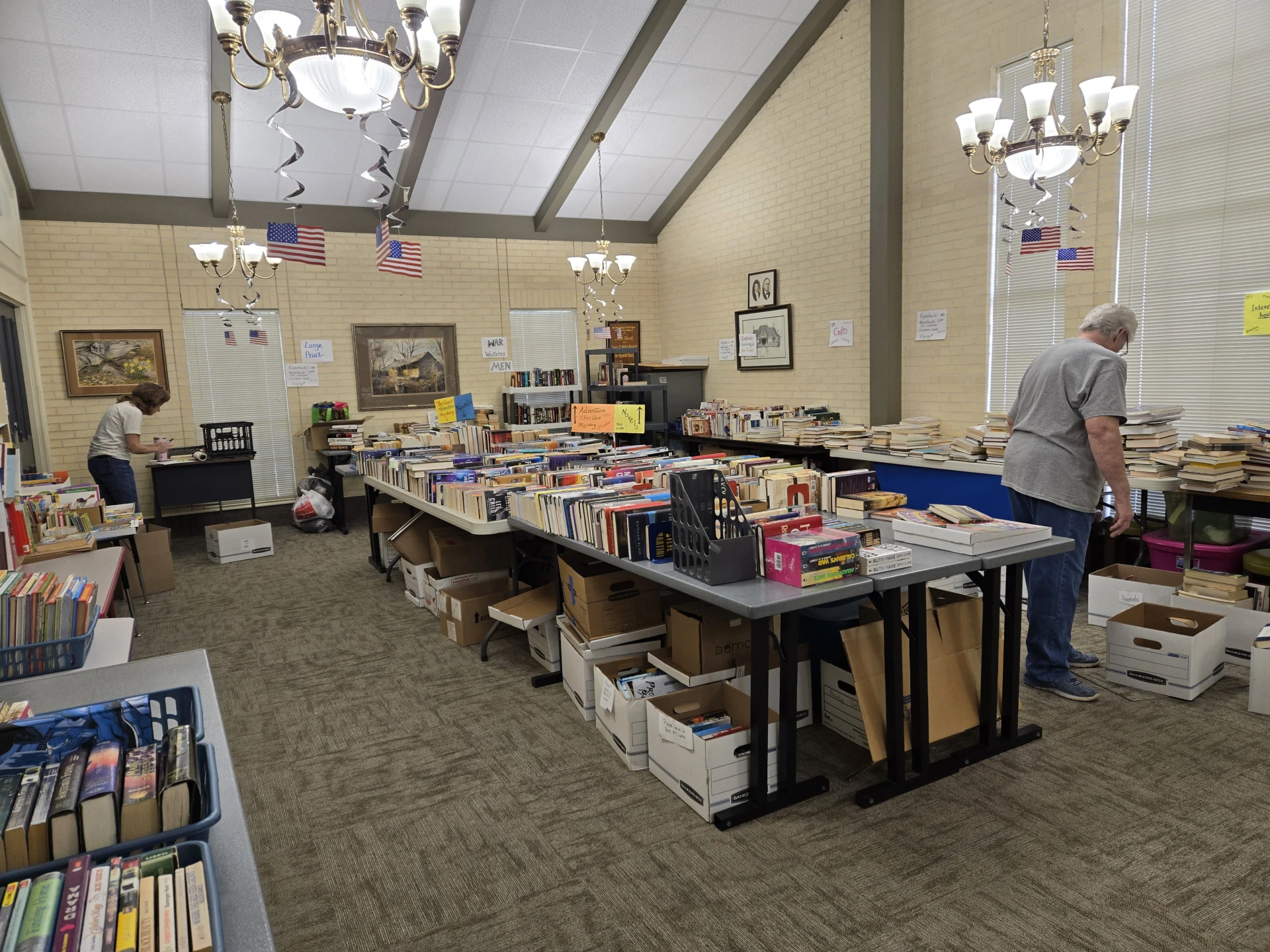
Fannie Brown Booth Library Preparing for FOL Fall Booksale

The Friends of the Library of the Fannie Brown Booth Library are busy preparing for their fall booksale which benefits the library by providing funds to purchase new books and support other projects.

Volunteers have been busy setting up tables and sorting books for the sale. We have lots of books of all kinds, even lots of children's books for sale. The book sale will start on Tuesday, November 3rd and continue throught Saturday, November 7.

It will be held during regular library hours. Come save some money by purchasing books at bargain prices. Hardback books are $1.00, paperback books will cost 50 cents, and children's books are 3 for $1.00. For more information, call the library at 598-5522.


Roy Davis

Fannie Brown Booth Memorial Library

619 Tenaha Street

PO Box 1329

Center, TX 75935

936.598.5522

fbbl.roy@yahoo.com

Fields tops Toledo Bend for Bassmaster Elite Qualifier win

MANY, La. — Ethan Fields came to the dock convinced he had blown it. An hour later, he was holding the first-place trophy at the Nitro Boats Bassmaster Elite Qualifier at Toledo Bend Reservoir presented by Bass Pro Shops.

Following two consistent days with limits of 28 pounds, 2 ounces and 27-4, which put him in fourth place, then first, the pro from Carlyle, Ill., entered Championship Friday with a 3-6 lead.

After two days of showing off its impressive quality and quantity, Day 3 saw Toledo Bend feeling the full effects of a lake turnover that started with a pre-event cold front. With the fish clearly having a bad hair day, Fields managed only 17-13, but that was enough to tally a winning total of 73-3, that edged Buddy Benson of Dahlonega, Ga., by 2-7.

For his efforts, Fields won the $71,317 top prize. He also received an invitation to fish the 2027 Bass Pro Shops Bassmaster Classic presented by Under Armour, March 19-21 at Lake Hartwell.

“I was confident that I didn’t have it; 17 pounds on this lake — there’s no way,” Fields said of his unexpected win. “My family left at 4 in the morning and drove down. This is so special. I can’t believe it.

“With these guys in the Top 10, I thought there was no way I could keep up with them. I don’t know what to say, this is so incredible.”

Fields caught all of his final-round fish in the same area where he caught his first two days’ limits. Working a creek north of the Pendleton Bridge, uplake from the tournament site, Fields fished a variety of habitat features including timber flats and docks.

“I was just doing big circles in there,” Fields said. “I only left the creek twice to go try some new stuff and it wasn’t working, but that was one place where I knew there was fish. So, I went back to that creek, hunkered down and got it to work.

The first two days, Fields also caught fish cruising the bank and hunting big gizzard shad. On the final day, however, his bank fish were nowhere to be found.

“I had a really slow day, it was really tough on me,” Fields said. “The conditions didn’t bother me until today. The lake finished turning over and the fish were running from my baits. They did not want to eat today.

“It’s a good thing the tournament started a couple days earlier or it might have been a really poor tournament for Toledo Bend.”

Fields caught most of his fish on a Hideup Coike Fullcast rigged on a 1/0 BKK Hyperlatch treble hook with a 1/8-ounce weight. He also caught fish on a jighead minnow with a Big Bite Baits Spotlight Minnow on a 1/4-ounce head or a larger minnow on a 3/8-ounce head.

With either bait, precision casts and quick retrieves were the key ingredients.

“It seemed like you had to hit these fish right on the head this week,” Fields said. “With the docks, I was staying a couple of feet out in front of the docks, because the closer you are, the better you can see them on forward facing sonar.

“Even if I was fishing super shallow, it seemed like they wanted the bait moving quickly past them.”

At the Day 2 weigh-ins, Fields stated that he felt very confident throughout his day. Suffice to say, Day 3 brought a very different vibe, as his bites were  less frequent, and he never found what Toledo Bend standards would call a big bite — something 7-plus.

Fortunately, Fields started his morning with a 5-pounder 30 minutes into his day and quickly followed with one about 2 3/4. After that, his day yielded only four more bass, but one of them was another 5.

Benson enjoyed a strong start with a Day 1 limit of 30-3 that put him in third place. Adding 21-13 in the second round kept in the No. 3 spot, but Benson gained one notch on Championship Friday by adding 18-12 for a tournament total of 70-12.

“I felt like I kinda fumbled today, but I came in and checked BassTrakk and I was like, ‘Wow, everybody kinda struggled,’” Benson said. “The first day, I could do no wrong and the last two days, it just got tougher and tougher.

“Today, it was hard to see one on the screen to throw at. It seemed like they were leaving me by the minute.”

Benson caught one of his fish on an urchin bait and the others on a jighead minnow. For the latter, he used a 1/8-ounce jighead with a 7-inch Deps Sakamata Shad to weed out smaller fish and appeal to the big ones that were eating gizzard shad.

Jace Lindsay of Beckville, Texas finished third with 69-1. His daily weights were 28-1, 19-11 and 21-5.

Lindsay said he caught all but one of his 15 tournament weight fish on a Deps Sakamata Shad with a 1/8-ounce head. A Hideup Coike Fullcast rigged on a quad hook with a 1/16-ounce weight produced one of his limit fish.

“They weren’t really set up on the spots like they normally are, so I was just trolling around good areas and (using forward facing sonar),” Lindsay said. “Maybe a wolf pack chasing gizzard shad would roll through and I’d catch one on the minnow.

“Once the sun got up, I’d rotate brushpiles and timber stretches that I know are good.”

Ty Faber of Pagosa Springs, Co., won the $500 Phoenix Boats Big Bass award with a 9-0.

Kaden Buchmann of Troutman, N.C., leads the Nitro Boats Bassmaster Elite Qualifiers presented by Bass Pro Shops standings with 244 points. Brody Robison of Dawson, Ala., is in second place with 239, followed by Brennan Flick of West Monroe, La., with 223, Peyton Harris of Birmingham, Ala., with 221, and Cody Abbott of Woodruff, S.C., with 220.

A field of 131 anglers competed in the second of three “EQ” events. The series began at Norfork Lake (Sept. 23-25) and concludes at Lake Guntersville (Nov. 11-13). After the final event, the Top 10 anglers in EQ points standings will qualify to fish the 2027 Progressive Bassmaster Elite Series.

Toledo Bend Lake Country hosted this event.


2026 Bassmaster Elite Qualifiers Series Title Sponsor: Nitro Boats

2026 Bassmaster Elite Qualifiers Series Presenting Sponsor: Bass Pro Shops

2026 Bassmaster Elite Qualifiers Series Platinum Sponsors: Progressive, Toyota
2026 Bassmaster Elite Qualifiers Series Premier Sponsors: Bass Pro Shops, Humminbird, Mercury, Minn Kota, Mountain Dew, Nitro Boats, Ranger Boats, Rapala, Skeeter Boats, Yamaha
2026 Bassmaster Elite Qualifiers Series Supporting Sponsors: AFTCO, Daiwa, Lew's, Lowrance, Phoenix Boats, VMC, Yokohama


About B.A.S.S.

B.A.S.S., which encompasses the Bassmaster tournament leagues, events and media platforms, is the worldwide authority on bass fishing and keeper of the culture of the sport, providing cutting-edge content on bass fishing whenever, wherever and however bass fishing fans want to use it. Headquartered in Birmingham, Ala., the organization’s fully integrated media platforms include the industry’s leading magazines (Bassmaster and B.A.S.S. Times), website (Bassmaster.com), TV show, radio show, social media programs and events. For more than 50 years, B.A.S.S. has been dedicated to access, conservation and youth fishing.


The Bassmaster Tournament Trail includes the most prestigious events at each level of competition, including the Progressive Bassmaster Elite Series, Turtlebox Bassmaster Opens Series presented by Battery Tender, Nitro Boats Bassmaster Elite Qualifiers Series presented by Bass Pro Shops, Mercury B.A.S.S. Nation Qualifier Series presented by Lowrance, Strike King Bassmaster College Series presented by Bass Pro Shops, Strike King Bassmaster High School Series, Tackle Warehouse Bassmaster Junior Series, TNT Fireworks Bassmaster Team Championship, Newport Bassmaster Kayak Series presented by Native Watercraft, Bassmaster College Kayak Series, Yamaha Bassmaster Redfish Cup Championship presented by Skeeter and the ultimate celebration of competitive fishing, the Bass Pro Shops Bassmaster Classic presented by Under Armour.

-30-

Connect with #Bassmaster on Facebook, Instagram, Twitter and TikTok.

Media Contact: Mandy Pascal, Communications Manager, 334-414-8677, mpascal@bassmaster.com


2026 Nitro Boats Elite Qualifier at Toledo Bend presented by Bass Pro Shops 10/21-10/23
Toledo Bend Reservoir, Many  LA.
(BOATER) Standings Day 3

   Angler                   Hometown              No./lbs-oz  Pts   Total $$$

1.  Ethan Fields           Carlyle, IL             15  73-03  127  $71,317.00
  Day 1: 5   28-02     Day 2: 5   27-04     Day 3: 5   17-13   
2.  Buddy Benson           Dahlonega, GA           15  70-12  126  $20,975.00
  Day 1: 5   30-03     Day 2: 5   21-13     Day 3: 5   18-12   
3.  Jace Lindsay           Beckville, TX           15  69-01  125  $16,780.00
  Day 1: 5   28-01     Day 2: 5   19-11     Day 3: 5   21-05   
4.  Lucas Lindsay          Auburn , AL             15  67-09  124  $15,941.00
  Day 1: 5   27-07     Day 2: 5   19-03     Day 3: 5   20-15   
5.  Brody Robison          Dawson, AL              15  67-00  123  $15,102.00
  Day 1: 5   23-15     Day 2: 5   25-10     Day 3: 5   17-07   
6.  Riley Harris           Orange, TX              15  66-06  122  $14,263.00
  Day 1: 5   30-10     Day 2: 5   21-06     Day 3: 5   14-06   
7.  Yui Aoki               Minamitsurugun JAPAN    15  65-07  121  $13,424.00
  Day 1: 5   19-00     Day 2: 5   25-09     Day 3: 5   20-14   
8.  Bailey Gay             Union, KY               15  64-15  120  $12,585.00
  Day 1: 5   23-04     Day 2: 5   21-07     Day 3: 5   20-04   
9.  Luke Palmer            Atoka, OK               15  62-13    0  $11,746.00
  Day 1: 5   32-14     Day 2: 5   13-10     Day 3: 5   16-05   
10. Fisher Anaya           Eva, AL                 15  60-06    0  $10,907.00
  Day 1: 5   24-10     Day 2: 5   21-08     Day 3: 5   14-04   
-----------------------------------------------------------------------
BIG BASS OF TOURNAMENT
     Ty Faber                 Pagosa Springs, CO  09-00        $500.00
-----------------------------------------------------------------------
Totals
Day   #Limits    #Fish      Weight
 1       110       616      2057-00
 2        98       577      1910-05
 3        10        50       182-05
----------------------------------
         218      1243      4149-10
Federal inmate convicted of using his time in prison to defraud local family and others

BEAUMONT, Texas – A federal prison inmate has been convicted in an investment fraud scheme in the Eastern District of Texas, announced U.S. Attorney Jay R. Combs.


Riley Graham, 60, also known as David Drake, was found guilty by a jury of conspiring to commit wire fraud.  The verdict was reached on October 15, 2026, following a five-day trial before U.S. District Judge Marcia A. Crone.


According to information presented in court, from June 2019 through October 2024, Graham, while imprisoned at the low security correctional facility at the Bureau of Prisons Federal Correctional Complex (BOP-FCC) in Beaumont, conspired with others to devise and execute a scheme to defraud others, including a Beaumont pastor, his family, and the owners of a North Carolina construction business, of over $1.4 million.  Graham, who had previously been convicted of perpetrating a federal fraud scheme, began another scheme to defraud those he had access to – including a fellow inmate and his family.  


The maximum statutory sentence prescribed by Congress is up to 30 years in federal prison, a potential fine, and restitution at sentencing.  The maximum statutory sentence is provided here for information purposes, as the sentencing will be determined by the court based on the advisory sentencing guidelines and other statutory factors.  Sentencing hearings will be scheduled after the completion of presentence investigations by the U.S. Probation Office.

This case was investigated by the FBI, Internal Revenue Service-Criminal Investigation, Homeland Security Investigations, and Bureau of Prisons and prosecuted by Assistant U.S. Attorneys John B. Ross and Chris Jackson.

Center Christian Fellowship Invites Community to Hallelujah Night 2026

CENTER, TEXAS — Center Christian Fellowship invites families throughout Shelby County and surrounding communities to join us for Hallelujah Night 2026, Saturday, October 31, from 6:00 to 8:00 p.m.

At Center Christian Fellowship, we believe that all 365 days of the year belong to God — including October 31! Rather than focusing on a worldly holiday, we choose to make this evening an opportunity to celebrate Jesus Christ, share His love, and provide children and families with a fun, safe, and Christ-centered environment.

Hallelujah Night is our way of giving back to the community while bringing families together for an evening of laughter, excitement, and good Christian fellowship.

This year’s celebration promises something for everyone! Activities will include a Glow-in-the-Dark Cake Walk, Gaga Ball, face painting, obstacle course, sports arena, bounce houses, hayrides, and plenty of exciting games!

And what’s a celebration without delicious food? Families can enjoy pizza, s’mores, homemade ice cream, popcorn, and cotton candy!

Best of all, everything is FREE, FREE, FREE! There is no admission charge, and all activities and refreshments are provided at no cost.

Our desire is to offer children a wonderful evening filled with fun and lasting memories while reminding them that Jesus is the reason we have so much to celebrate.

Event Details:

Hallelujah Night 2026

Saturday, October 31, 2026

6:00–8:00 p.m.

Center Christian Fellowship

2471 US Highway 96 North

Shelby County Memorial VFW Post 8904, wreath-laying ceremony

On Sunday morning, October 23, 1983, at 6:22 a.m., a suicide bomber drove a truck packed with explosives into the Battalion Landing Team headquarters of the U.S. Marine compound at Beirut International Airport. Minutes later a second truck bomb struck French peacekeepers nearby. The attacks killed 241 Americans — 220 Marines, 18 sailors, and three soldiers — the deadliest single day for the Marine Corps since Iwo Jima during World War II.

Those service members were part of the Multinational Force sent to Lebanon as peacekeepers during the civil war. About 300 troops were housed in the four-story building that collapsed in seconds.

Forty-three years later, Shelby County Memorial VFW Post 8904 will honor them with a wreath-laying ceremony at the Veterans Memorial on the grounds of the 1885 Historic Courthouse, Center, Texas, at 10:00 a.m. on Friday, October 23, 2026.

Fellow veterans and the public are invited to attend.

THE ICE HOUSE BY: NEAL MURPHY

THE ICE HOUSE
BY: NEAL MURPHY
SAN AUGUSTINE, TX 75972

A bit of nostalgia always overtakes me as I turn north off W. Columbia
street on to N. Bolivar street in my small town. At what used to be 107 N.
Bolivar stands the remains of the San Augustine Ice Company. At one time
this thriving business contributed greatly to the welfare of the citizens of San
Augustine.
To me, a pre-teen in the middle forties, the ice house meant a twenty-five
pound block of ice used to make mother’s fabulous ice cream. Usually on
Friday afternoons my father, Cecil, would drive up to the platform and ask
Mr. A. H. (Top) Cartwright to get him a block of ice. Soon Mr. Cartwright
would bring this sparkling cold commodity to the front of our 1941
Chevrolet, and gently place it between the front bumper and fender with his
metal ice tongs. It would ride quite nicely there as we drove home.
While dad used an ice pick to chip up the block of ice, mother made her ice
cream recipe, using a packet of “Junket” mix. My job was to sit on top of
the old hand cranked ice cream maker so that dad could turn the handle.
Usually after about twenty minutes the creamy delicacy was ready to eat.
I recall the time that the ice house installed an ice crusher machine. Now
one of the jobs of ice cream making was eliminated. Instead of dealing with
a block of ice, it was placed in the crusher and out came crushed ice, being
much more convenient to use.
Ice was a very important commodity in the very early days of San
Augustine. Most homes had ice boxes which kept food cool by use of a
block of ice in the top. During WW II there was a German prison camp
here. The local folk always resented the fact that the prisoners received the
first supply of ice in the morning. I never knew why this was so, but do
remember the complaining.
The San Augustine Ice Company, phone number 67, was much more than
the maker of refrigerated ice. It was also a meat curing and storage facility.
In fact, 1938 saw 10,747 pounds of pork, beef, and venison cured by the

Morton method, and stored in their vaults. In 1940 the ice company
introduced the “Belshaw Snow-Ice Merchandiser” which was installed in
Metteaurer’s Food Market. It involved crushed ice being placed in trays
under the fruits and vegetables which kept them crisp and fresh much longer.
Belshaw later became a large restaurant supplier of various equipment.
Also in 1940, the ice company introduced the Coolerator, which was an ice
conditioned refrigerator. It claimed “Ice cubes in 5 minutes” for a mere
$84.50, or a smaller version for $54.50. The more expensive of the
Coolerator Ice Refrigerators contained a special copper ice cube maker
whom the manufacturer, Duluth Refrigeration Corporation, claimed could
make ice cubes using hot water.
This ice cube maker looked like an ice cube tray, but had a container across
the top in which to pour in hot water. The Coolerator was them placed upon
the top of a block of ice and melted down into a special ice pick that cut the
cubes loose through a small hole. The final result was a perfect square ice
cube that could be used in front of the finest company. The feeling was that
crushed ice was rather common and not suitable for Sunday dinner.
An interesting fact about the Coolerator was that each of the spindly wooden
legs was immersed in a one pound coffee can half full of kerosene. This
kept crawling or climbing insects out of the ice box. Screen wire sides and
doors kept out the flies and gnats.
The year was 1934 when the largest hog ever brought for curing weighed
over 600 pounds. It was owned by Clabe Byley of the southern part of the
county.
The San Augustine Ice Company had as its board of directors: Mr. J. R.
Greer, President, Mr. B. J. Butts, Vice President, Mr. A. O. Rushing, Mr.
John D. Clark, and Mr. R. C. Downs, with the General Manager being Mr.
A. H. Cartwright.
As the Deep East Texas Electric Co-Operative expanded electricity into the
rural areas, more people purchased electric refrigerators which not only did
not need ice, but made ice themselves. Thus began the decline of the
demand for ice and other facilities. The San Augustine Ice Company began
a slow death and eventually closed down, thus ending an era that saw our
community no longer needing their services. I suppose that was progress.


Leadership Shelby County Graduation

The Shelby County Chamber of Commerce Leadership Shelby County Class of 2024-2025 was recently honored with a graduation celebration.  

Chamber President, Deborah Chadwick congratulated the class during opening remarks.  Diplomas were presented to the 2024-2025 graduating class.  A donation to the Fannie Brown Booth Memorial Library has been made in honor of the Leadership Class 2024-2025.

Class members are:  Ginger Borders, Farmers State Bank; Felicia Cloudy, Center ISD; Clay Ihlo, Shelby Savings Bank; O’Neal Jones, City of Tenaha; Courtney O’Rear, Children’s Advocacy Center; Laura Romero, Shelby Savings Bank; Feleshia Thompson, Texas A&M Extension Agency; Misty Wright, Work Force Solutions.  

Leadership Shelby County is a nine month long program presented by the Shelby County Chamber of Commerce designed to identify potential leaders and develop within these individuals the knowledge, skills and vision necessary to enable them to actively participate in the enhancement of the quality of life in their communities.

Each month, starting in October, with a “hands on” approach, the class studies specific topics including Heritage, Local Government, Economic Development, Health and Social Services, Agriculture, Education and Quality of Life.

Thank you to all the local leaders and businesses for sharing your time and knowledge.  Also, a huge thank you to Center ISD transportation department for transporting us all over the county each month.
 

Farmers State Bank Announces the Winners of their Third Annual Photo Contest


Farmers State Bank Announces the Winners of their Third Annual Photo Contest 
Center, Texas – Farmers State Bank announces the winners of this year’s third annual photo contest. 

Landscape/Nature Category:
1st Place:  Janice Carter “Two Sisters”
2nd Place:  LeaAnn Robertson “Mesa Mansion”
3rd Place:  BJ Wood “Lovers Spat”


Fine Art Category:
1st Place:  Lawrence Davis “World Upside Down”
2nd Place: Billie F. Jones “Decades of Labor”
3rd Place: Lawrence Davis “Hiding in the Shadows”


Human Interest Category:
1st Place: Danny Pickens “Asleep at the Reel”
2nd Place: BJ Wood “That’s What I Like about Texas”
3rd Place: Julie Cantrell “Goodbye”


Best in Show Category: 
Janice Carter “Two Sisters”


All of the contest entries are on display in the lobby at the bank’s corporate location on 115 Shelbyville Street, Center, Texas. The public can vote for the “People’s Choice” award in the lobby through July 1st.  The contest received 72 entries this year with photographers from Milam, White House, Nacogdoches, Center, Joaquin, Tenaha and Timpson.  
This year’s judge is photographer Elton Scifres.  Mr. Scifres has a gallery in Nacogdoches that he shares with his wife.  He is also the current chairman of the Nacogdoches Photography Club.
Farmers State Bank is currently celebrating 121 years in business.  From 1904 – 2025 the bank has served as a source of financial strength to meet the needs of its market areas by offering a comprehensive range of financial products and services to meet the needs of individuals, businesses and government entities.  
Whether it be with direct personal contact with our customers or with the use of the extensive online services offered, Farmers State bank remains dedicated to the tradition of being a true “Community Bank”.
Learn more at www.fsbctx.bank.

Battle of the Badges

Its Year # 5 for Battle of the Badges, and we are switching things up!
This year’s battle will be

Center Police Department vs Center Fire Department

Support your local Law Enforcement, and Fire Department and save lives!

The Gulf Coast Regional Blood Center will be set up outside the

Center Police Dept with 2 donor coaches from 10 am – 2:30 Pm
EVERY attempted donor will be entered into a raffle for cool door prizes!

Every successful donor will get a Donor Free T-Shirt. And a $25 ECard
To schedule a donation time, please go to 
WWW.GIVEBLOOD.ORG

Call Amy Lindley 936-598-2788       Or use this link  to schedule

https://www.commitforlife.org/donor/schedules/drive_schedule/388277

49th East Texas Poultry Festival Creative Arts Show Committee is looking for participants

49th East Texas Poultry Festival

Creative Arts Show Committee is looking for participants

The 49th Annual East Texas Poultry Festival, presented by Farmers State
Bank, is right around the corner – October 2, 3 and 4. Don’t miss this
opportunity to showcase your creative side in art, quilting, canning, crafts,
woodworking, metal art and photography.
All creative art divisions and are open to Youth (6 th through 12 th grades) and
Adults (17 and older). The art division will also be open to Elementary (K –
through 5 th ). The Creative Arts Show is sponsored by Doches Credit
Union.

The Quilt Show is sponsored by Scull Timber and the Photography Show is
sponsored by the Light and Champion.

Start taking photos, quilting quilts, canning your spring and summer harvest
and creating art for these events. We want to showcase and recognize
ALL our local talent.

Please visit the Chamber website www.shelbycountychamber.com for a
complete list of the rules for each event along with entry forms that need to
accompanied with your entry. Or contact the Chamber at 936-598-3682 or
email at info@shelbycountychamber.com.

Archives:

2026-11 | 2026-10 | 2025-08 | 2025-07 | 2025-06 | 2025-05 | 2025-03 | 2025-02 | 2025-01 | 2024-12 | 2024-11 | 2024-10 | 2024-09 | 2024-08 | 2024-07 | 2024-06 | 2024-05 | 2024-04 | 2024-03 | 2023-12 | 2023-11 | 2023-10 | 2023-09 | 2023-08 | 2023-07 | 2023-06 | 2023-05 | 2023-04 | 2023-03 | 2023-02 | 2023-01 | 2022-12 | 2022-11 | 2022-10 | 2022-09 | 2022-08 | 2022-07 | 2022-06 | 2022-05 | 2022-04 | 2022-03 | 2022-02 | 2022-01 | 2021-12 | 2021-11 | 2021-10 | 2021-09 | 2021-08 | 2021-07 | 2021-06 | 2021-05 | 2021-04 | 2021-03 | 2021-02 | 2021-01 | 2020-12 | 2020-11 | 2020-10 | 2020-09 | 2020-08 | 2020-07 | 2020-06 | 2020-05 | 2020-04 | 2020-03 | 2020-02 | 2020-01 | 2019-12 | 2019-11 | 2019-10 | 2019-09 | 2019-08 | 2019-07 | 2019-06 | 2019-05 | 2019-04 | 2019-03 | 2019-02 | 2019-01 | 2018-12 | 2018-11 | 2018-10 | 2018-09 | 2018-08 | 2018-07 | 2018-06 | 2018-05 | 2018-04 | 2018-03 | 2018-02 | 2018-01 | 2017-12 | 2017-11 | 2017-10 | 2017-09 | 2017-08 | 2017-07 | 2017-06 | 2017-05 | 2017-04 | 2017-03 | 2017-02 | 2017-01 | 2016-12 | 2016-11 | 2016-10 | 2016-09 | 2016-08 | 2016-07 | 2016-06 | 2016-05 | 2016-04 | 2016-03 | 2016-02 | 2016-01 | 2015-12 | 2015-11 | 2015-10 | 2015-09 | 2015-08 | 2015-07 | 2015-06 | 2015-05 | 2015-04 | 2015-03 | 2015-02 | 2015-01 | 2014-12 | 2014-11 | 2014-10 | 2014-09 | 2014-08 | 2014-07 | 2014-06 | 2014-05 | 2014-04 | 2014-03 | 2014-02 | 2014-01 | 2013-11 | 2013-10 | 2013-09 | 2013-08 | 2013-07 | 2013-06 | 2013-05 | 2013-04 | 2013-03 | 2013-02 | 2013-01 | 2012-12 | 2012-11 | 2012-10 | 2012-09 | 2012-08 | 2012-07

Family Features

Loading Family Features Content Widget
Loading Family Features Article