(WASHINGTON) -- U.S. military officials said Tuesday that an unmanned drone boat rescued two crew members aboard a U.S. Army Apache attack helicopter that crashed in the waters nears the Strait of Hormuz, which President Donald Trump said Iranians shot down.
U.S. officials are describing the rescue as the first time that an unmanned surface drone has been used to successfully rescue crew members at sea.
The AH-64 helicopter crashed at 7:33 p.m. EDT on Monday, leaving the pilots in the waters off Oman, according to U.S. Central Command.
"The Soldiers were safely rescued within approximately two hours and are in stable condition," according to a CENTCOM statement.
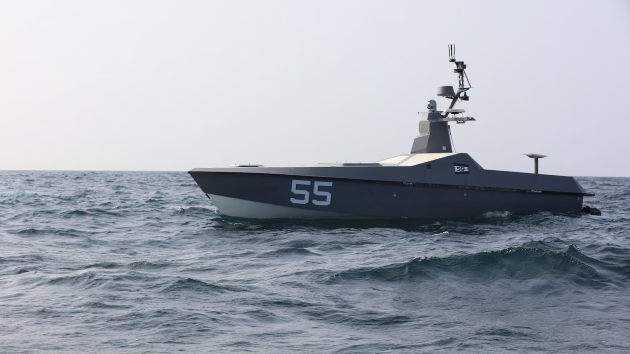
The Navy surface drone -- described by a U.S. official as looking like a speedboat -- located the two Apache crew members, who were then able to board the vessel, which transported them to another location on that water where they were then hoisted up to a helicopter for further transport, according to a U.S. official.
"The surface drone that assisted in last night's rescue of the Apache crew off the coast of Oman was a U.S. Navy Corsair unmanned surface vessel operated by U.S. 5th Fleet’s Task Force 59. The task force began fielding these drones in theater in late March," said Capt. Tim Hawkins, the spokesman for U.S. Central Command.
Trump said Tuesday afternoon that the military informed him Iran was to blame for the helicopter crash, vowing that the U.S. must "respond to this attack."
ABC News has reached out to the White House on whether the weekslong shaky ceasefire with Iran is now over.
What is Task Force 59?
Task Force 59 operates a variety of autonomous surface drones in the waters of the Middle East, as well as aerial drones. The task force, established in 2021, uses its unmanned drones to provide quick reconnaissance capabilities and integrate artificial intelligence to share with crewed warships operating in the region, according to the Navy.
With not enough manned vessels to maintain a constant awareness of what is going on in the Middle East's waters, the drones enhance the 5th Fleet's capabilities to detect smuggling and Iranian malign activity, Navy officials said.
"For pennies on the dollar we can put unmanned platforms out there, we can couple it with artificial intelligence … and then, I think critically important, we can use our manned ships much more efficiently, much more effectively,” then-5th Fleet Commander Vice Adm. Brad Cooper told reporters in October 2022 following a regional exercise to highlight the task force's capabilities. Cooper is now serving as the commander of U.S. Central Command.
The cost for the boat drone used to rescue the Apache crew is estimateed to be about $1.2 million per drone, according to a report from Sacra, a market research firm. That cost is extraordinarily cheap relative to traditional, manned military vessels.
Artificial intelligence is used to analyze patterns of behavior detected by the sensors aboard the drones, which is then shared with commanders and ships operating in the region.
In addition to the Corsair used in the operation, Task Force 59 uses other notable unmanned surface drones including the T-38 Devil Ray and the Sail Drone.
The Devil Ray is a high-speed autonomously operated unmanned surface vessel that is mainly used to gather intelligence, surveillance and reconnaissance, according to its manufacturer.
In one exercise in 2024, it successfully fired live munitions at a training target.
The Sail Drone looks just like its name implies, it is an autonomous water platform topped by a sail that provides power through wind and solar energy, according to its manufacturer.
A network of Sail Drones can provide a clearer at-sea situational awareness in hostile environments, according to its manufacturer.
Copyright © 2026, ABC Audio. All rights reserved.
.jpg)